The Household Archive and the Memory of a Family
A household which keeps no archive forgets itself within a generation. We consider the patient work of preserving the documents, photographs and decisions which constitute a family's institutional memory.
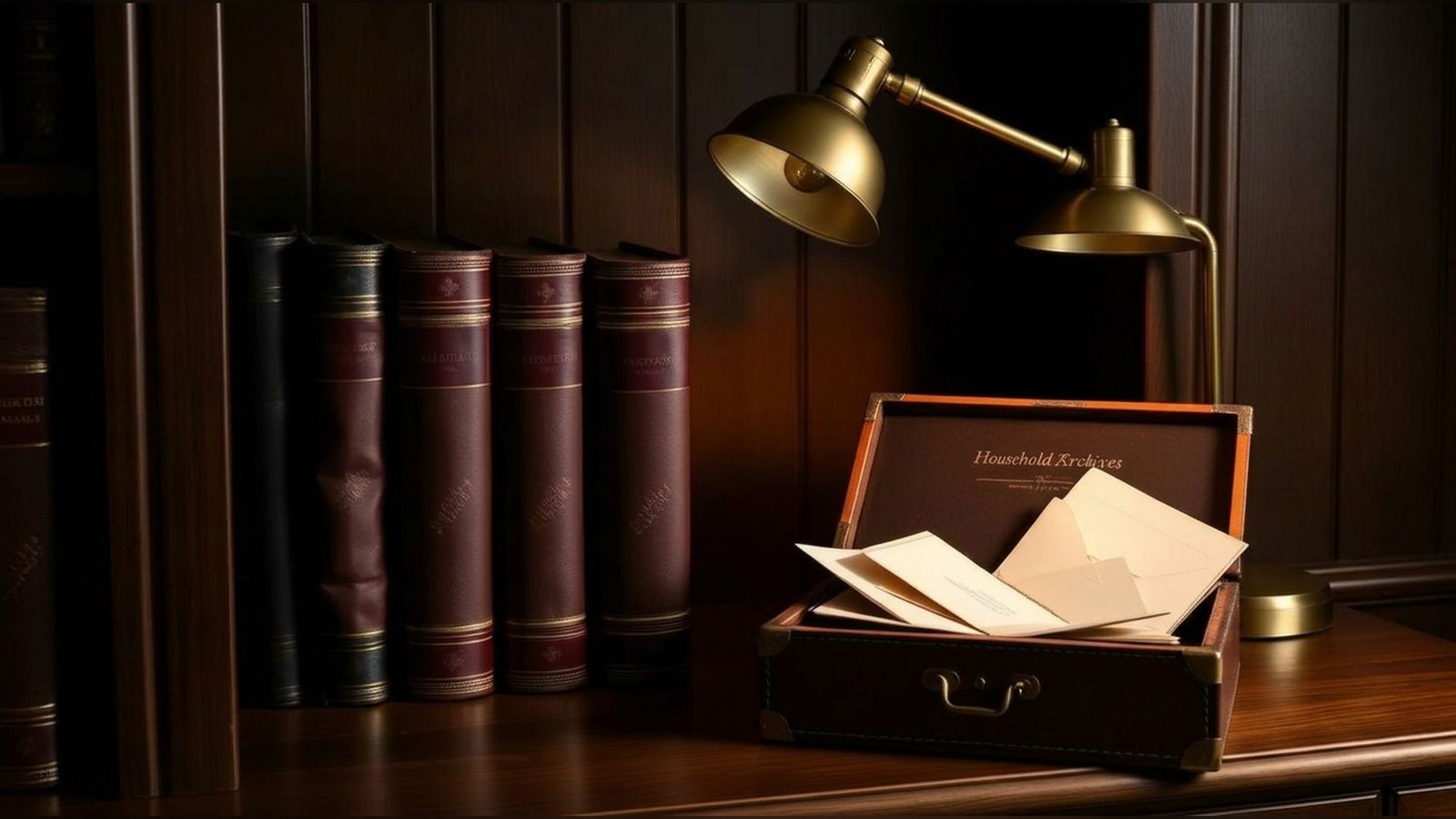
It is a sobering observation, made to us repeatedly across many years, that a family of considerable standing can, within a single generation, lose substantially all detailed knowledge of its own history. The photographs are scattered across several houses; the correspondence has been culled in successive household clearances; the decisions which shaped the family's affairs have left no written record beyond the legal documents that captured them at the moment of execution. By the time the third generation enquires about how a particular arrangement came to be made, the answer is, in many cases, no longer available to be given.
The household archive, properly understood, is the thoughtful remedy to this slow forgetting. The archive is not a museum; it is a working collection of the documents, photographs, correspondence and reflections that make up the institutional memory of the family. This collection must be kept in conditions which allow it to survive across generations and organised in a way which lets future members of the family consult it without specialist assistance.
We counsel principals to be thoughtful, rather than exhaustive, about what is preserved in the family archive. The archive which tries to preserve everything quickly becomes the archive which preserves nothing accessible; the sheer volume of material defeats any chance of finding anything within it. Our practice is to identify, in consultation with the principal and the senior generation of the family, the categories of material that carry genuine long term significance. We then apply careful editorial judgement at the point of acquisition. The personal correspondence between the founder and the principal of the next generation, yes; the routine commercial correspondence of forty years ago, in nearly all cases, no.
A family which preserves no record of its decisions is a family which makes the same decisions twice.
The physical conditions in which a family archive is held are routinely neglected in households which have otherwise given the matter careful attention. An archive stored in a basement room with seasonal humidity, or in an attic with summer heat, will degrade over decades in ways which are not visible until the damage is irreversible. We counsel that any archive of genuine significance be held in a room with stable temperature and humidity. More vulnerable material should be stored in archival-quality enclosures, and the most significant documents digitised as a precaution against the unexpected.
We close with a final observation on the role of the archive in the life of the next generation. A family member who has sat with the household archive, reading the correspondence of those who came before, carries a unique perspective into their own decisions. No oral account, however well intended, can fully convey it. The archive is, in this sense, the most patient teacher in the household. A principal who maintains it well has given the next generation a resource whose value will become apparent at moments the principal cannot foresee.


WRITTEN AND COMPILED BY OUR FOUNDER AND CEO, ROBERT WENNEKES
- GovernanceGovernance of the Modern Family Office
- GovernanceThe Thoughtful Family Constitution
- ServicePrivate Staff and the Possibility of a Normal Life
HouseholdThe Rhythms of the Winter Residence
A second residence is not a holiday house but a parallel household. We consider the staff, supplies and quiet rituals which allow the winter residence to receive the principal as if no time has passed.
Read essay