The Cellar and the Passage of Time
A serious private cellar is an exercise in patience and forethought. We discuss the quiet disciplines which distinguish a great cellar from a merely well stocked one.
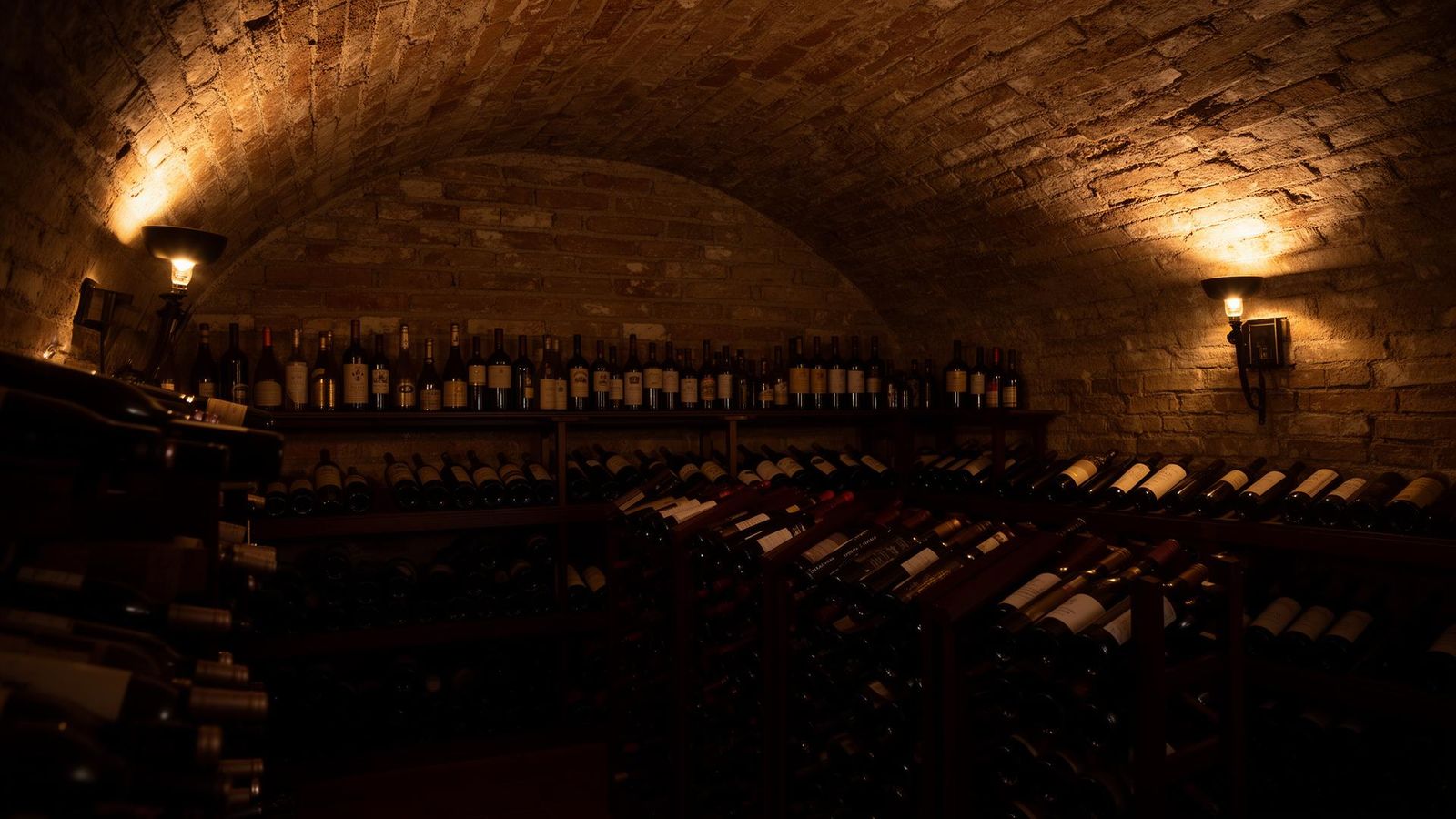
The private cellar is among the most satisfying institutions a distinguished household maintains. It rewards forethought and patience. It requires the willingness to make decisions today whose consequences will be enjoyed, decades from now, by oneself or by one's heirs. A cellar built with care over many years is a record of the household's hospitality, a source of considerable pleasure to its principal, and often an asset of meaningful value. A cellar assembled without thought becomes, within a few years, a collection of agreeable bottles that happen to share a room. It lacks the coherence which distinguishes a serious cellar from a simple accumulation.
As with a private collection of paintings, the first question to settle is the cellar's purpose. The honest answer differs from one household to the next. For some principals, the cellar exists chiefly to support the household's regular hospitality: the bottle opened on a Tuesday with the family, the wine offered at a small Saturday dinner, the older bottle brought out when the occasion warrants it. For others, the cellar is partly an investment in vintages whose merit will only be properly known a generation hence, and which may, in time, be sold or passed on rather than consumed. For others still, the cellar is an exercise in scholarship, an attempt to hold representative wines from particular regions or producers whose work the principal admires.
These purposes are not incompatible, but they imply quite different acquisition patterns. The cellar built for daily hospitality is replenished often, with bottles intended for relatively prompt drinking. The cellar built for the long view buys carefully and rarely, in quantities sufficient to allow the wine to be tasted at intervals of years and the household's experience of it to grow. A household which has not settled, between principal and cellar master, what the cellar is for will find its acquisitions drifting in directions that serve no clear purpose well.
A cellar of any seriousness requires conditions which are easy to specify and surprisingly often neglected in practice. Constant temperature and constant humidity. The absence of vibration. The absence of light at the wavelengths which damage wine. The absence of strong odours from neighbouring rooms. None of these is hard to achieve in a properly designed space. All, however, are routinely compromised in spaces converted from other uses. There, the underfloor heating, the laundry beyond the wall, or the seasonal swing of the building's air handling all work against the bottles in slow but perceptible ways.
We strongly recommend that any household contemplating the construction or renovation of a cellar engage a specialist whose work is verifiable, rather than the general contractor whose principal experience is in domestic interiors. The cost difference is modest; the consequences of getting the conditions wrong, on a cellar which may eventually contain wine of considerable value, are not.
A great cellar is recorded as carefully as it is stocked. The cellar book, whether on paper or in a database, is the institutional memory of the household's drinking. It records when each bottle entered the cellar, from which merchant or producer it was acquired, and its price. It also notes the occasion on which any particular bottle was opened. The household adds its note on the wine's development, and whether remaining stock should be drunk sooner or held longer. A cellar maintained in this disciplined way teaches its principal a great deal over the years. On eventual transfer to the next generation or to an auction house, it provides a record of provenance. This record materially supports both pleasure and value.
A bottle drunk without a note is, for the thoughtful cellar, a small lesson lost.
We close with a reflection which the most senior cellars eventually compel. A cellar built over forty years contains, by the time it is mature, bottles which the principal acquired in their thirties and which have, in the meantime, become considerably more valuable than they were at purchase. The question of what becomes of the cellar when the principal is no longer its custodian deserves the same careful attention which, in earlier essays, we have suggested be given to art collections and to other significant household assets. Some cellars are, in time, distributed among the family; some are sold to fund philanthropic intentions; some are passed entire to a son or daughter who has, over the years, shown the disposition to maintain them. None of these outcomes is wrong; each, however, is improved by being decided in advance, while the principal still has the inclination to give the matter the unhurried attention it merits.


WRITTEN AND COMPILED BY OUR FOUNDER AND CEO, ROBERT WENNEKES
- StewardshipThe Yacht as a Household at Sea
- StewardshipThe Family Art Collection as a Living Institution
- StewardshipInsurance and the Long Horizon of the Estate
HouseholdThe Quiet Craft of the Household Driver
The private driver is, in any well ordered household, far more than a chauffeur. We discuss the disciplines which distinguish the role at its best.
Read essay