The Private Cigar and the Art of the Leaf
A fine cigar is the patient work of soil, weather, and the human hand across many seasons. We consider the private cellar of cigars, the care it requires, and the quiet tradition it represents.
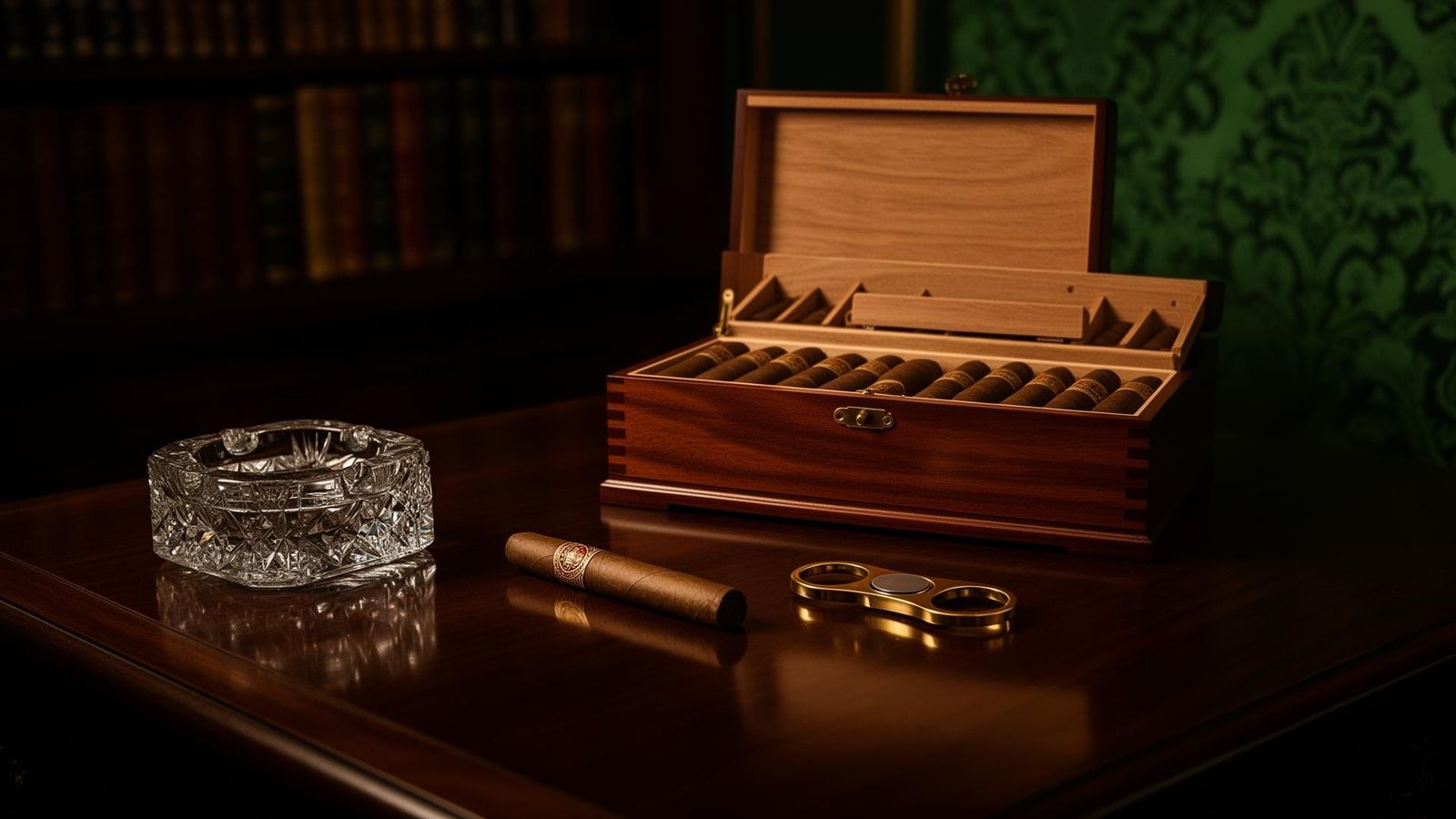
In residences which have kept the practice, there is a small room or a deep cabinet where a private cellar of cigars is maintained. It is rarely spoken of and almost never displayed. The details are known only to the principal and the staff member to whom its care has been entrusted. Within it rests the result of a tradition which begins in the soil of a particular valley, passes through the patient hands of growers, sorters, and rollers, and arrives, at length, in the company of the gentleman who will one day light it.
We are sometimes asked, by principals new to the matter, why so much should be made of what appears, on first acquaintance, to be a simple object. The answer lies in what the object actually is. A serious cigar is the compressed work of three or more years; the cultivation of the plant, the selection and curing of the leaf, the long fermentation in bales, the precise rolling, and the final patient ageing in cedar. To treat it as anything less than the agricultural and artisanal achievement it represents is to misunderstand the tradition entirely.
The cigar in its modern form is a comparatively recent matter, though the cultivation and ceremonial use of the leaf in the Americas precedes European contact by many centuries. The diplomatic and mercantile traffic of the seventeenth, eighteenth, and nineteenth centuries carried the practice into the libraries of Europe. There, it was unobtrusively adopted by men of affairs as a settled close to the working day. By the late nineteenth century the great houses of Cuba, the Dominican Republic, Nicaragua, and Honduras had established the standards by which serious cigars are still measured today. These standards rest, as they always have, on the character of the soil, the patience of the curing barn, and the steady judgement of the master roller.
A cigar is the slow accumulation of seasons; to hurry it at any stage is to spoil it.
The principal who is forming a private cellar will, in our counsel, do best to begin by tasting carefully across origins rather than by accumulating quickly within a single house. The cigars of Cuba retain a particular character which no other terroir reproduces; the Dominican Republic offers a refined and balanced expression of the leaf; Nicaragua brings depth and a recognisable strength; Honduras a directness which many serious smokers value above all else. None of these is superior in any absolute sense. The question is which character agrees with the principal's own palate. The answer is found only through patient and unhurried tasting over many months.
We counsel a small standing relationship with one or, at most, two trusted merchants of long reputation, rather than the casual purchase from whichever shop happens to be at hand. The merchant who knows the principal's preferences becomes, over the years, a discreet contributor to the principal's pleasure. This is a person who sets aside particular boxes from particular vintages, and who advises against a purchase as readily as in favour of one. As with the visiting horologist or the family physician, the right merchant is rarely the most visible; the relationship is built with care and held for many years.
A cigar is a living object until the moment it is lit, and it requires of its keeper the same steady attention any other living thing in the residence is given. The humidor, whether a fine cabinet of Spanish cedar in the library or a dedicated walk-in room in the larger establishment, must be held at a humidity of close to seventy percent and a temperature near eighteen degrees, year round. The instruments are checked weekly by the member of staff to whom the cellar has been entrusted, and a small log is kept in which any unusual reading is noted at once. A cellar permitted to drift too dry loses, in a matter of weeks, what may have taken a decade of patient ageing to acquire.
We close with a reflection on the measured civility a well-kept cellar represents. At the end of an evening of serious conversation, a principal may offer a guest a cigar. Drawn from a cellar which has been thoughtfully assembled and properly kept, it is an offer of something which cannot be improvised. It cannot be bought in haste. The gesture is small and unspoken; the tradition behind it is long. The impression it leaves is of a household where the patient disciplines, in this matter as in others, are being diligently observed.


WRITTEN AND COMPILED BY OUR FOUNDER AND CEO, ROBERT WENNEKES
- HouseholdPrivate Staff Duties and Compensation
- HouseholdService Across Borders and Cultures
- HouseholdThe Mutual Care of House and Family
EstateThe Equestrian Establishment as a Household
A serious stable is not an amenity but a household in its own right. We examine the staff, standards and disciplines which distinguish a thoughtful equestrian establishment.
Read essay