The Invisible Work of Excellence
Why the finest service is often the least noticed, and why the quiet absence of fuss is the truest mark of a household held to its standard.
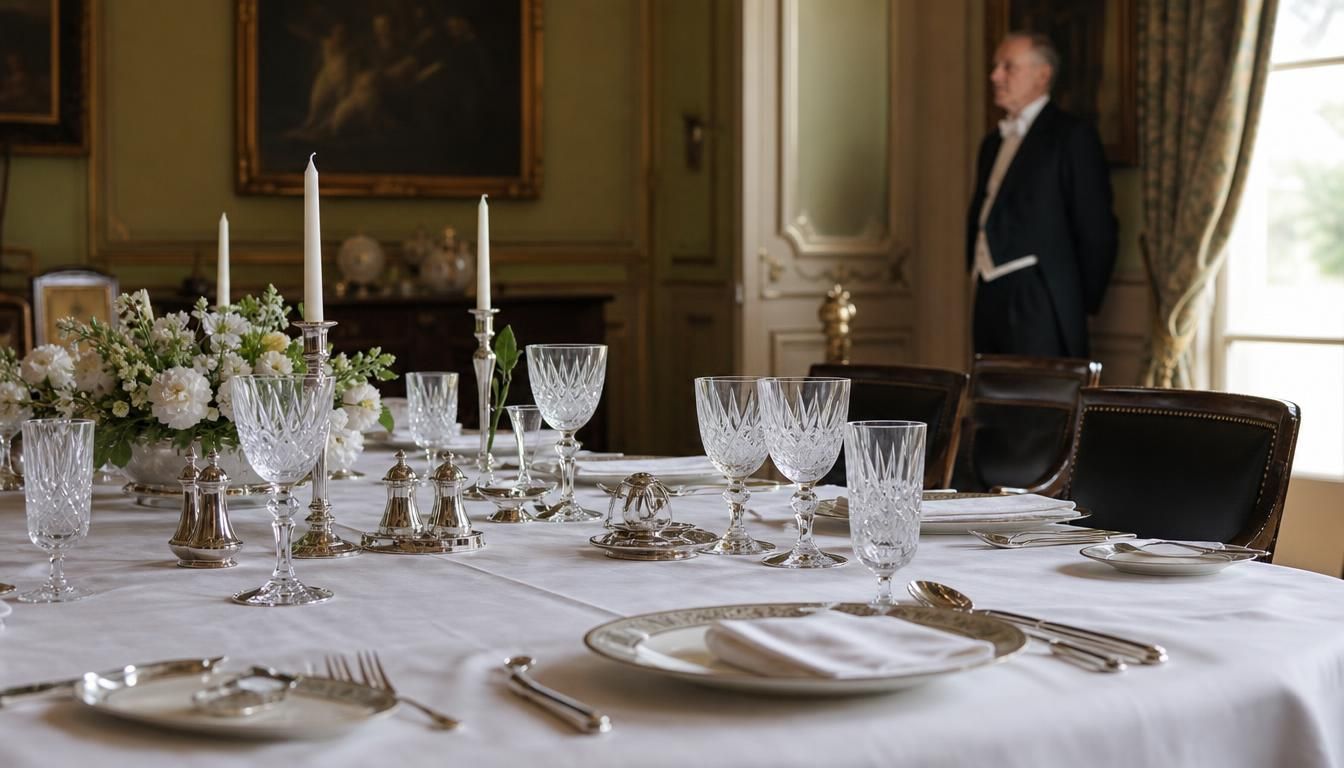
There is a common misunderstanding about excellence in private service, which is that it announces itself. The visitor to a great house is sometimes expected to notice the polish of the silver, the precision of the table, the quiet choreography by which a coat is taken, a drink is offered, and a guest is shown to the right chair. In truth, the very best service is rarely noticed at all. It is felt as a kind of ease, a sense that things are simply as they ought to be, and that one has arrived in a place where no small difficulty will be allowed to reach the principal or the guest. The mark of the finest households is not that one remembers the service, but that one forgets it was ever necessary.
This invisibility is not accidental. It is the result of a great deal of visible labour, conducted long before the moment in question. The butler who appears at the door at the exact moment a guest is ready to depart has spent the previous hour anticipating the rhythm of the evening. The housekeeper who leaves a room looking untouched has, in fact, restored it to a condition so exact that the eye passes over it. The chef whose meal seems effortless has tasted, adjusted, and rehearsed each element until the final plate arrives as though it could not have been otherwise. What the guest experiences as absence, the staff know as the summit of their craft.
A young member of private staff sometimes imagines that distinction will come from being noticed: the clever solution, the graceful recovery, the moment of personal charm. There is a place for these qualities, but they are not the foundation. The foundation is the daily choice to remove oneself from the principal's field of attention. This means entering a room only when required, leaving before one has become an object of notice, and conducting every small task in such a way that the principal's consciousness is never interrupted by the mechanics of the household.
We have observed, over many years, that the staff members who rise to the most trusted positions are those who understand this discipline instinctively. They do not need to be told to step back from a conversation. They do not require correction before a formal dinner. They anticipate the moment in which their presence would become felt, and they are elsewhere. The result is that the principal, and the principal's guests, move through the day with the pleasant sensation that the house itself is quietly competent, rather than the awareness that a particular person is working hard to make it so.
The highest compliment a guest can pay a household is to leave unable to name a single member of the staff.
In most professions, excellence is recognised by what one produces: the building, the verdict, the published account, the completed transaction. In private service, the product is the absence of disturbance. The staff member's finest work is, by its nature, difficult to describe afterwards, because it consists of the things that did not go wrong, the awkwardnesses that did not occur, and the small embarrassments that were absorbed before they could become visible. This is why the profession requires a particular temperament, one that is content with judgement rather than applause.
The principal who understands this does not look for theatrical competence. They look for the person who can be trusted to hold a standard when no one is watching, who will correct a misalignment not because it will be noticed, but because it is not aligned. They look for the housekeeper who straightens a picture that has been tilted by a passing draught, the butler who replaces a chipped glass before it reaches the table, the chef who sends back a delivery because the produce is a fraction below the house's standard even though the principal would never have known. These are acts of invisible professionalism, and they are the true substance of a great household.
It would be a mistake to think that invisible work is unrewarded. Its reward is of a different order from public recognition, but it is no less real. The staff member who consistently removes difficulty from the principal's path becomes, over time, indispensable. They are consulted before decisions are made, included in conversations from which others are excluded, and trusted with the parts of the family's life that are never visible to the outside world. Their reward is not praise at a dinner party; it is the quiet knowledge that the household could not be what it is without them.
We close with a reflection for principals as well as for staff. The finest households are those in which the principal has learned to value the unseen. They do not mistake bustle for industry, or visibility for competence. They understand that the person who appears to do least may, in fact, be the one who has made most things unnecessary. They appreciate that a quiet evening, a smooth departure, an unremarkable dinner party, and a morning in which nothing required their personal intervention are all the result of a great deal of invisible work, conducted by men and women who have made invisibility the mark of their excellence.


WRITTEN AND COMPILED BY OUR FOUNDER AND CEO, ROBERT WENNEKES
- ServicePrivate Staff and the Possibility of a Normal Life
- HouseholdService Across Borders and Cultures
- HouseholdThe Mutual Care of House and Family
HouseholdPrivate Staff Duties and Compensation
A measured account of what senior private staff actually do in a distinguished household today, how their compensation is properly arranged, and why the headline salary is rarely the most important figure on the page.
Read essay