The Making of a Butler
How a butler is actually formed. The schools, the long apprenticeship of the house, and why a certificate is only the opening page of the profession.
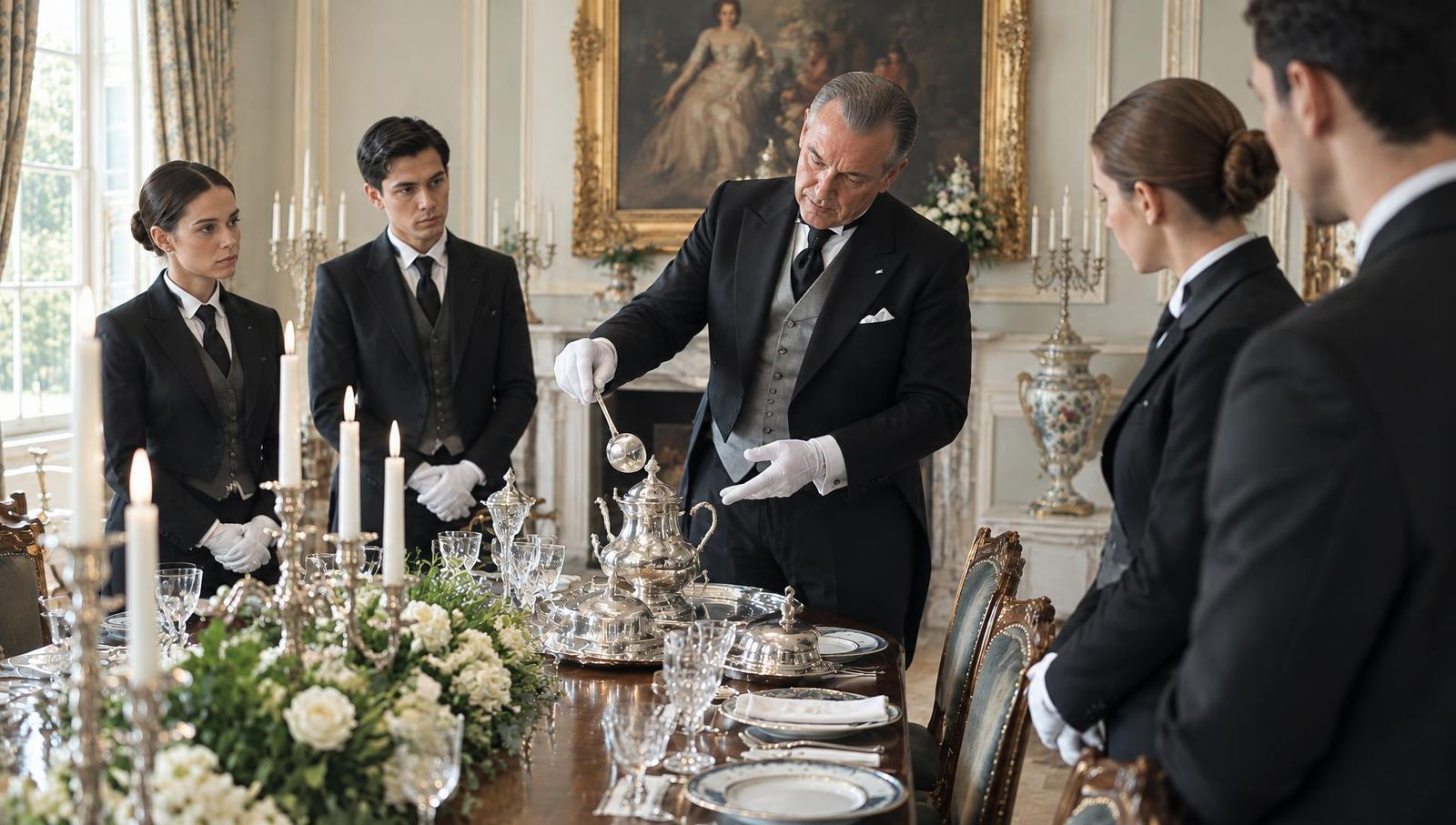
Of all the questions put to our office, few are asked with more genuine curiosity than how a butler comes to be one. The popular imagination retains a picture of the profession drawn from another century. It assumes that the men and women who carry the title today were born to it, or inherited it from a parent, or were recruited from some village and trained in place across decades. The truth is both more ordinary and more interesting. A butler is made, deliberately and over many years, by a combination of formal instruction, supervised practice, and the long apprenticeship which no school can supply.
The question matters to principals as much as it matters to the profession. A principal who understands how a butler is formed will recruit better, judge candidates more fairly, and understand what a serious appointment asks of the house itself. The subject is timely, too. The demand for properly trained private staff has grown considerably in the last thirty years, and the supply of genuinely formed professionals has not always kept pace with it.
A proper school teaches the grammar of the profession. The student learns the order of service at table, the handling and presentation of silver, the packing and care of a wardrobe, the management of linen, the rudiments of wine and its cellar, the receiving of guests, the drafting of correspondence, and the protocols which govern service in the presence of royalty, of government and of faith. Programmes vary in length from several weeks to a full year, and they vary almost as much in seriousness. The best of them insist on repetition until the technique is no longer thought about, because a butler who is thinking about his technique is a butler who is not watching his room.
What no school can supply is judgment. Judgment is acquired only in houses. It is acquired by standing behind a chair at a dinner of twelve and reading, without being told, that a guest has been given the wrong glass. It is acquired by absorbing the rhythms of a family over months, until the household moves as one. The schools give the technique. The houses give the profession.
Most butlers of quality begin in a junior capacity, as a footman, a houseman, an under butler, or an assistant in a larger establishment. This is not a period to be skipped. In these years the young professional learns what no classroom demonstrates: the pace of a working house, the mechanics of a formal dinner for twenty, the discipline of being unseen while being everywhere, and the particular requirements of a family whose preferences must be learnt to the smallest detail and never forgotten.
The length of the apprenticeship varies. A gifted professional in a demanding house may be ready to take charge of a modest establishment within a few years. Most require rather longer. What separates the eventual senior butler from the professional who remains forever competent is not speed but depth: the accumulation of a thousand small correct responses, and the temperament which allows them to be delivered without visible effort.
The schools teach the hand. The houses teach the eye. The profession is learnt only where the two are joined.
A principal interviewing a trained candidate should regard the certificate as an assurance of vocabulary rather than a guarantee of ability. The questions which matter are of a different order. Where has the candidate served, and under what sort of principal? How does he describe the most difficult service he has managed? What does he ask about the house? The answers reveal whether the training has been converted into practice, and whether the temperament beneath it is equal to the position.
References deserve particular attention in this profession, precisely because so much of the work is unwitnessed. A butler operates for years in rooms which no employer observes. The reference of a previous principal, or of the senior member of staff under whom the candidate served, is therefore the most reliable document in the file, and it should be read with more care than the certificate which sits above it.
It would be wrong to suggest that the butler is formed entirely by schools and by previous houses. The present house forms him as well. A principal who provides clear expectations, honest feedback, proper equipment, reasonable rest and a genuine interest in the growth of his staff will find that good butlers become better in his service. A principal who treats the position as a purchasable commodity will find that even the best trained candidate declines in his house, because the profession cannot be practised well without respect.
The finest households understand this. They treat the formation of their staff as part of the stewardship of the house itself. They send junior staff to courses. They pair young professionals with senior ones. They document the preferences and the protocols of the family so that knowledge is preserved rather than held in a single memory. These are the households in which careers of twenty and thirty years are made, and in which the household itself becomes, in time, a school.
Formal training now has its own respectable institutions in Europe, in America and in Asia, and our own Academy in Normandy was founded on precisely this conviction: that the standards a distinguished household requires do not maintain themselves, but must be handed on, deliberately, from one generation of professionals to the next. A profession which forgets how to form its own members will not remain a profession for long.
A butler, in the end, is not manufactured. He is cultivated, over years, by institutions which take the craft seriously and by households which give the craft its practice. The principal who understands this will read a candidate's history with more understanding, will set a more realistic expectation of what a first appointment requires, and will take his own place in the long chain of transmission by which the art of private service is preserved.

WRITTEN AND COMPILED BY OUR FOUNDER AND CEO, ROBERT WENNEKES
- ServicePrivate Staff and the Possibility of a Normal Life
- ServiceThe Invisible Work of Excellence
- HouseholdPrivate Staff Duties and Compensation
ServiceThe Dangerous Difference Between Service and Servility
Service asks for humility, never for the surrender of dignity. We examine where the one ends and the other begins, and why the profession must speak of it.
Read essay